> ## Documentation Index
> Fetch the complete documentation index at: https://docs.missions.eutika.com/llms.txt
> Use this file to discover all available pages before exploring further.
# Learning, Validation and Onboarding
export const VideoCard = ({videoSrc, title}) => {
return ;
};
## **What is a Mission?**
An **active learning experience** designed to develop one or more functions corresponding to a **professional profile**, where the learner faces a challenge similar to what they should solve in a work or professional context.
The experience is based on ***escape room*** logic and, through a series of clues and resources, guides the person through successive stages, where they must achieve a series of milestones that are part of the necessary sequence of results to solve the challenge. It is possible to modulate the intensity and formats of **support**, so that a mission can function as a validation or learning tool.
The **evaluation** is based on direct evidence of solving the challenge and its stages, which constitute robust proof that the person demonstrates sufficient performance of the target functions of the mission.
## **Types of missions**
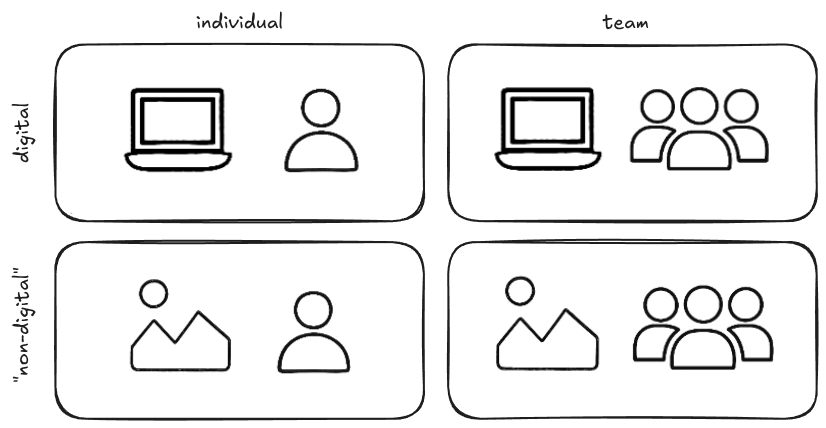
Missions was born as a tool to design and operate **missions related to digital profiles**, meaning those in which all activities to be performed to solve the challenge are executed in **digital services that are integrated with the Missions platform** and therefore generate a digital trace that allows for granular monitoring and generates intelligence about user behavior and not only about their learning evidence (at the end of stages and at the end of the mission).
Subsequently, the design framework has been expanded to incorporate **"non-digital" missions**, understood as those in which **part of the learner's activities occur in physical/analog environments** (for example, work sessions, "paper" designs, work in laboratories or workshops...). In this case, the mission designer must consider that the greater the number of stages and learning evidence, the greater the possibility of monitoring, evaluation, and feedback. Therefore, they must establish a compromise between the level of monitoring (which implies an additional workload for the learner who must encode their results to be able to share them) and the opportunities to observe and accompany the person.
Additionally, **Missions was born as individual learning and validation**. At present, our framework already allows designing **missions that must be solved as a team**. In this case, a set of professional functions necessary to address the challenge is defined and those functions are assigned to several person profiles who must work collaboratively. Each team user executes those functions and generates the corresponding evidence according to the functions they have assigned. To achieve this, they sometimes must coordinate and interact with the rest of the team using coordination mechanisms that the team decides or that the mission itself determines. **The mission design can leave open the assignment of roles and responsibilities in each stage to people** (in this case the team must coordinate to define them) **or can establish them in the design itself**.