
Technology
Missions Platform
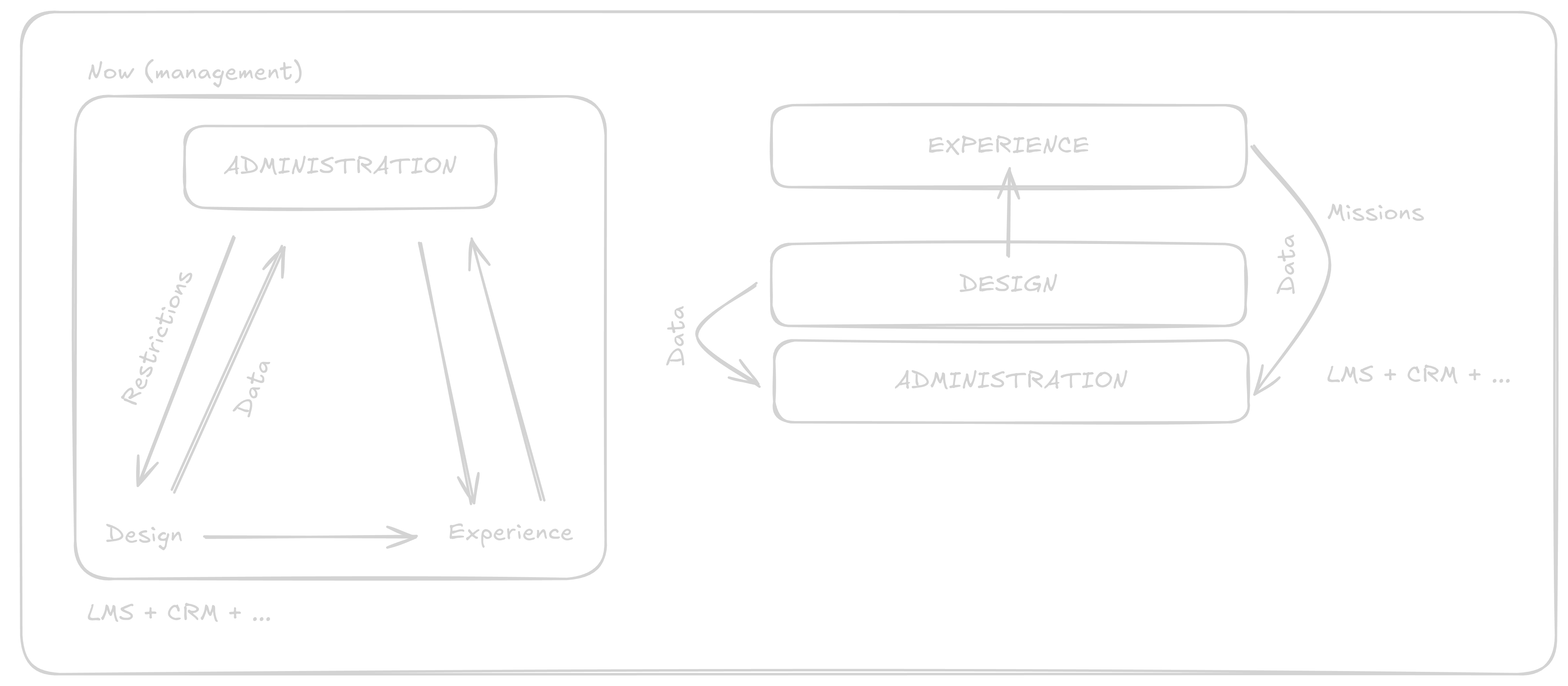
The technological platforms that support learning or talent development processes, particularly LMS or CRM systems, are focused on process administration. They are designed and serve the administrators of organizations responsible for coordinating these institutional processes to ensure their efficiency. This in itself is not a problem… The problem is thinking that these are the only necessary functions or the most critical for the organization.
As a consequence of their approach, existing LMS platforms or educational CRMs establish restrictions on the design process of the educational offer (courses, programs, pathways, experiences, activities…). They are tools that, rather than providing design functionalities, limit it and cause the true design process to generally happen “outside the platforms” (designers often limit themselves to dumping “content” at the end of the process). The perverse effect is that a good part of the data generated in design and in the learning experience either are not recorded or, if they are recorded, remain in disconnected silos (which can range from teachers’ personal files to the platforms’ own databases that do not facilitate the connection of diverse data).
Finally, the educational offer is designed without adequate digital tools (generally document templates or spreadsheets) so that the reuse of previous designs (of courses and activities but also of profiles, functions and competencies) is greatly hindered. Moreover, it is almost never possible to generate learning data intelligence or, if achieved, it is done with much effort and a posteriori (limiting its application in learner support).
On the other hand, these platforms are usually monolithic: they try to incorporate all the functionalities that are considered necessary (almost always with very deficient design and operation experiences) instead of following a stack logic and interoperability between platforms specialized in diverse functionalities.
In contrast, our educational and technological approach is “design-driven” and user-centered. Thus, Missions focuses on the functionalities of designing and experiencing learning experiences. Therefore Missions is not an LMS nor does it intend to be, but it does connect flexibly with LMS and CRM to configure a technological stack that allows digital infrastructures to evolve from a model centered on administration to one centered on users (designers and learners) and oriented to strategic learning design.
Missions allows designing and operating learning courses, programs or activities (that can be launched or connected from an LMS) and guarantees interoperability and communication with other platforms (for example, a CRM). It is the organization’s decision which parts of management and experience they want to happen in Missions or in other platforms.
Regarding design, the objective is to provide a visual and interactive environment (inspired by tools like Miro or Notion) and coherent where learning objectives, experiences, evaluation and support are connected. Regarding the experience, Missions and its teaching-learning frameworks are oriented so that the student / learner “gets out of the screen” and learns actively in contexts relevant to their objectives (which at its extremes can involve from developing software on other digital platforms to implementing actions in public spaces).